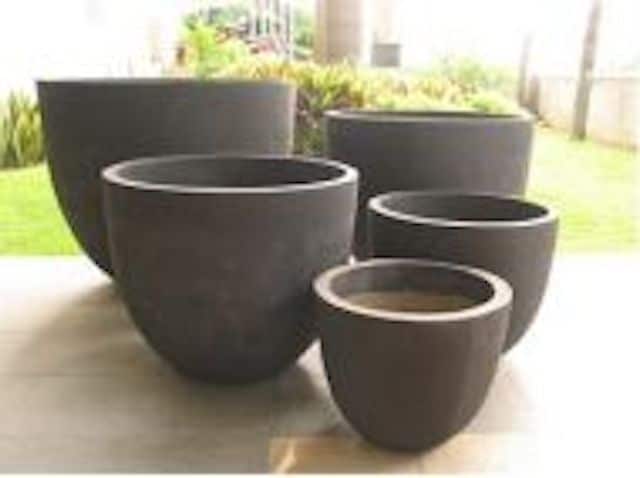
About Egg Planters
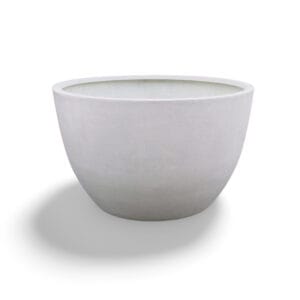
The widest point of an egg planter sits at mid-height, not at the rim. That one curve does two jobs. It takes the hard edge off rendered walls, retaining courses and paved pool surrounds, and it gives roots more room below the surface than the opening at the top would suggest.
Polystone Resin is what makes the shape practical. It reads as masonry from two metres away, yet the smaller sizes can still be lifted and repositioned by one person partway through a planting job. The composite does not draw in water from routine irrigation, and it holds its rigidity season after season, indoors or out.
Sizes step up in five stages: CG5008XL/40 (40 x 34), CG5008XL/50 (50 x 42), CG5008XL/63 (63 x 52), CG5008XL/75 (75 x 63) and CG5008XL/90 (90 x 75). Anything bigger in the same silhouette takes you to the Extra Large Egg Planter or the Giant Egg Planter. After eighteen years of watching people choose pots on the showroom floor, my advice is to take three consecutive sizes rather than three at random — the step between them then looks deliberate instead of accidental. Largest at the back with the upright specimen, the two smaller ones forward with something that spills. The rest of the shape family sits in our Polystone Resin Planters collection. If you are matching a pot you already own, or sizing to one particular corner, contact us about a product or project.
What plants suit the oval shape?
The wide middle carries a single upright specimen well — dwarf citrus, a fiddle-leaf fig indoors, an olive, a flowering camellia. Because the sides swell before they turn back in, there is also room at the rim for an underplanting: dichondra, creeping thyme, or trailing ivy left to spill over the edge.
Which sizes work together in a cluster?
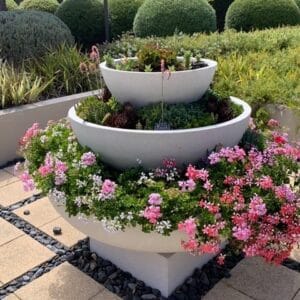
Three consecutive sizes — 75 x 63, 63 x 52 and 50 x 42 — set out as a triangle. Largest goes to the back corner and takes the upright plant. Keep the mounding or cascading foliage in the two forward vessels so nothing at the front is hidden by anything behind it.
Is there anything to do about drainage before planting outdoors?
Check the hole in the base is clear before you start. Lay permeable drainage mesh or geotextile fabric across it so the media stays where you put it, then fill with an open-structured potting mix made for containers. Surplus water should leave the pot rather than sit in the bottom of the curve.
Will it be safe on timber floors or carpet?
Indoors, leave the tree or houseplant in its nursery grow-pot and stand a heavy-duty waterproof drip tray inside the base of the egg. Watering then drains into the tray instead of onto floorboards, carpet or polished tiles, and you can lift the grow-pot out when the tray needs emptying.
What keeps the composite surface looking right?
It is a smooth, closed surface, so the work is mostly dust and rain splash caught in the curve rather than staining. Fresh water and a soft cloth deal with that; add a mild biodegradable detergent if a film has built up. Steel wool, harsh scourers and abrasive compounds will dull the sheen on a finish this smooth, and every scratch shows, so keep them away from it.