



About Oblong Planter Boxes
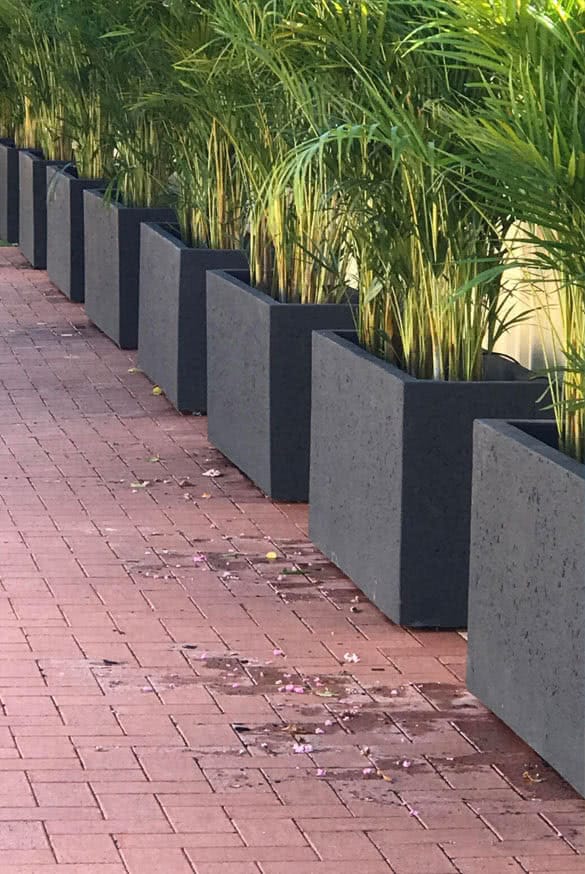
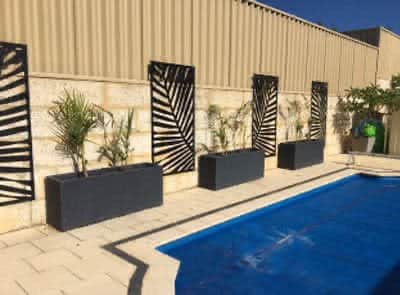
A clipped hedge roots better in one continuous cavity than in a row of separate pots. That is the case for these oblong boxes: straight vertical walls, square rectangular corners and an unbroken soil run down the full length, whether they edge a contemporary garden border, an alfresco dining area or a commercial boundary screen. Decorative grasses and mixed ornamental displays take the same advantage.
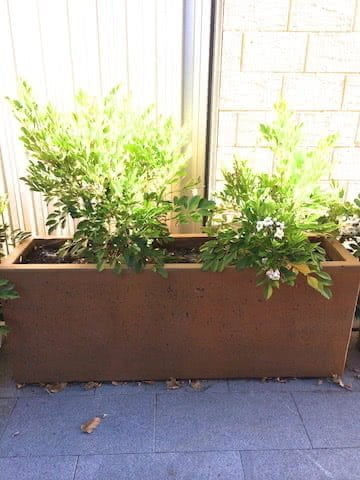
The pigment is integral to the finish rather than a coat sitting on the surface, so the colour keeps its depth. Interiors are waterproofed before the boxes leave the factory, larger sizes carry internal reinforcement to handle the load of a full planting depth, and two models — LS7034N/100 and LS7034/150 — sit on an integrated underneath frame that raises the drainage openings off paving, timber decking and garden floors to keep air and water moving beneath the base.
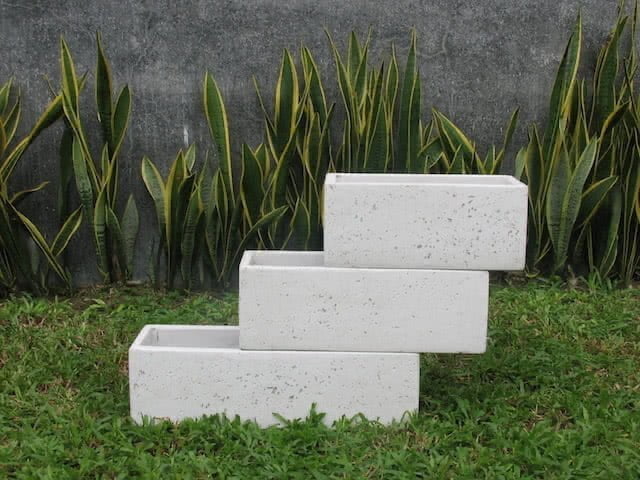
Six coordinated sizes run from a 60 cm trough that fits beside a courtyard step to a 150 cm box that reads as a low planted wall. Work out what each size will take in media with the potting mix calculator before you order. For matching troughs in the same finish, view the Light Stone collection.
What goes into the base before the potting mix?
Four layers, in this order: a piece of fibreglass flyscreen mesh over the bottom drainage hole, a layer of 20 mm blue metal aggregate across the base, a second piece of flyscreen over the aggregate so soil cannot wash down into the stones, then a quality container potting mix matched to your plant selection.
Why do LS7034N/100 and LS7034/150 sit on an underneath frame?
The frame lifts the base of the trough slightly clear of the ground, so the drainage apertures never sit flush against smooth paving or a timber deck. Surplus irrigation water runs straight away instead of collecting beneath the planter.
Which plants suit a long rectangular trough like this?
Formal perimeter hedging is the obvious use — Syzygium ‘Big Red’, Murraya paniculata or Portuguese Laurel all take the continuous root run well. For something less clipped, combine dwarf mother-in-law’s tongue with upright bamboo and let cascading silver pony foot spill over the front edge.
Why are the interiors sealed at the factory?
Composite walls that stay saturated from regular garden watering eventually show it. The internal waterproof barrier keeps that moisture off the wall from the inside, which prevents damp staining coming through to the pigmented exterior and preserves the structural integrity of the walls over years of use.
Can the pigmented surface be pressure washed?
No — a pressure washer will scour the pigmented surface and dull it. Rinse the exterior walls with a low-pressure garden hose instead, then wipe them over with a soft sponge, warm water and a little mild dishwashing liquid. Keep abrasive scourers and caustic chemical agents away from the finish entirely.