About TOV Glass Fibre Trough
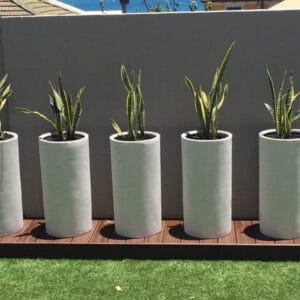
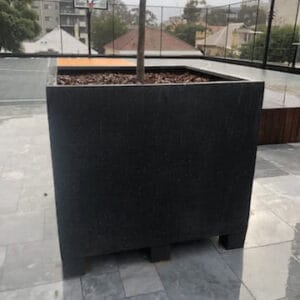
Glass fibre reinforcement runs right through the wall of this trough rather than sitting as a skin over a filler, which is why a knocked corner tends to mark rather than chip. Nothing mineral has been added to bulk out the mix, so the tare weight stays low enough for one-person handling, repositioning and seasonal replanting. The form is plain rectangular geometry, which is what you want for a run of planting along a fence line, a driveway edge or the open side of a covered entertaining area.
Water is the other half of the story. Glass fibre does not draw moisture into the wall, so there is nothing to rot, swell or blow out where a trough sits under automated irrigation, beside a pool or in a courtyard that stays humid all summer. The reinforced walls also hold their shape under wet soil, which is the load that matters most once the 119.5 cm size is filled and planted.
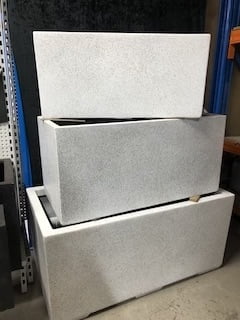
Pick the size by the run you need to fill. 119.5 x 64 x 55 draws a line across a courtyard or screens one seating area from another; 100 x 47.5 x 48 suits a spot with the depth but not the length; 85 x 34.5 x 40 works on a narrower ledge or in a pair either side of a doorway. Measure before you commit — the 64 cm width on the largest trough is the dimension most people underestimate. View the trough planter collection for other lengths, or contact us about a product or project and we will check the sizes against your plan.
Why pure glass fibre rather than a filled composite?
Tensile strength is continuous through the matrix, so the wall resists accidental knocks and chipping instead of fracturing at a filler boundary. It also weighs less than a mineral-filled composite or cast stone of the same size, which is the trade-off most buyers are actually making.
Will it cope beside a pool or under daily irrigation?
Yes. The material is non-porous, so it takes on no water and has nothing in it to rot or degrade under automated irrigation, splash-out from a pool, or the standing humidity of a covered pool house or enclosed garden terrace.
What needs doing at the base before I fill it?
Check the drainage apertures are clear, then lay synthetic mesh or geotextile fabric over each one so soil does not wash through. Fill with an open-draining potting mix chosen for what you are planting, and make sure water leaving the base can run away from the trough rather than pooling under it.
Is it light enough for a balcony or a timber deck?
Yes. Empty, pure glass fibre weighs a fraction of precast masonry, which keeps the container’s own deadweight down on timber decking, balconies and rooftop terraces where the structure sets the limit. Soil and water still make up most of the finished weight, so plan for the filled load, not the empty one.
Cleaning — what works on the composite shell?
The shell is smooth and sealed, so dust, leaf tannin marks and irrigation splash sit on the surface rather than soaking in. A soft sponge with clean water and a mild detergent takes them off; rinse and let it air dry. Keep wire brushes and solvent-based cleaners off it — both cut into the resin surface and leave a dulled patch that cannot be buffed back.