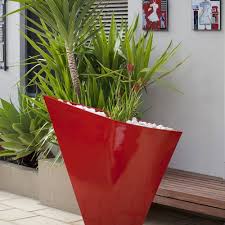
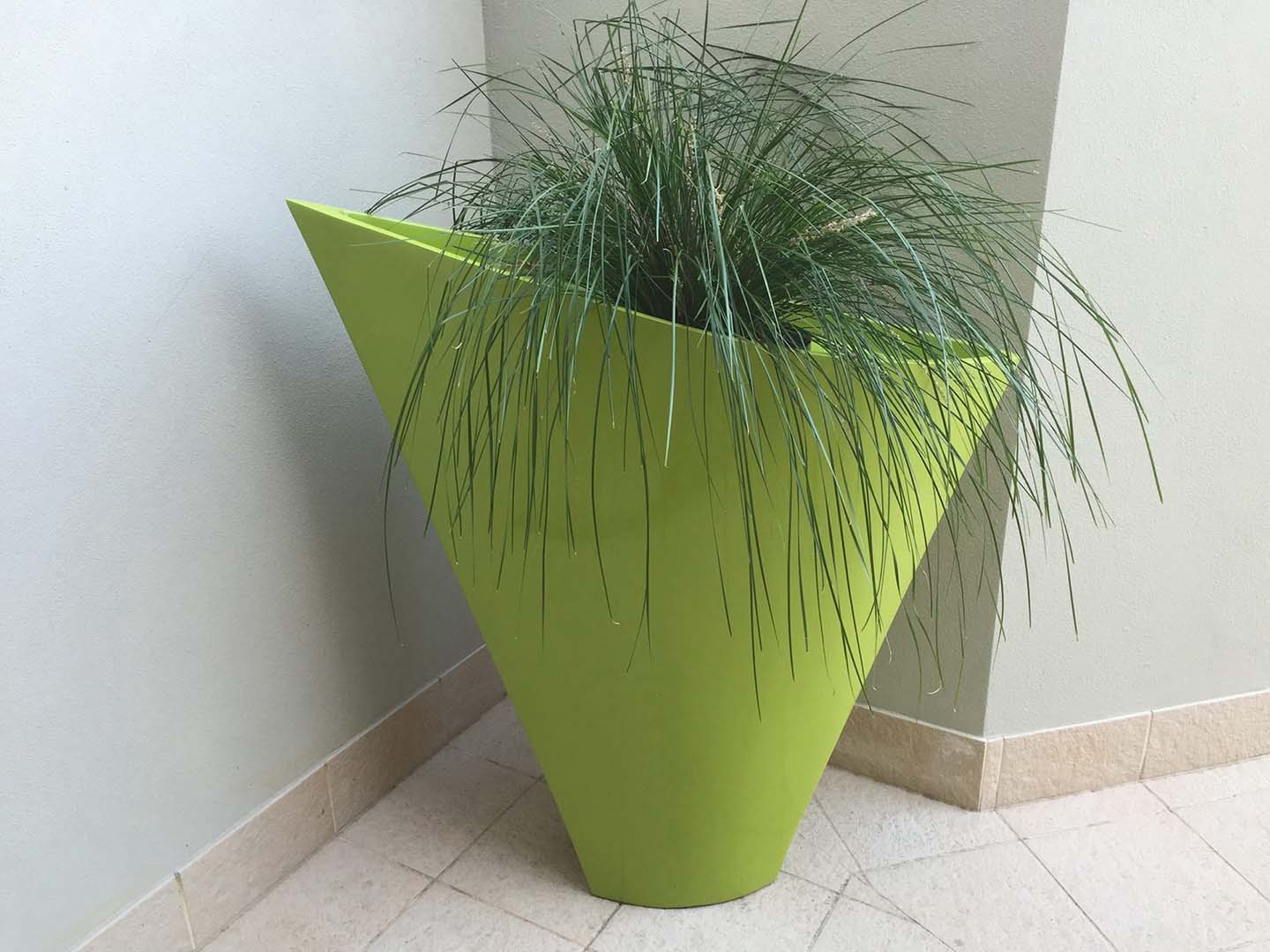
About Mars Urn
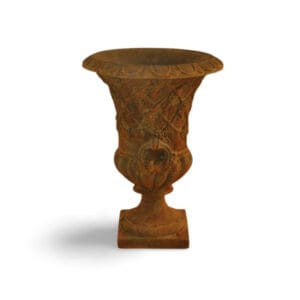
At 1150 x 1130 mm, the Mars Urn is sized to be read from across a foyer rather than studied up close, and it needs a plant to match. Pure fibreglass is what makes that scale practical. The same form cast in concrete or high-fired terracotta weighs far more, so this one stays light enough to carry through a standard gateway, simple to shift on a patio, and comfortable on an upper-level balcony or a timber deck where heavier materials are harder to place.
The reflective high gloss is the other half of it. That surface picks up light and whatever stands around it, so Red, White and Black read quite differently in a glazed foyer than they do under a pergola, and that is a call better made in front of the finishes than on a screen. Behind the coating, the pure fibreglass shell is rigid enough to live outdoors permanently through Perth summers and coastal wind, and light enough to reposition if the planting scheme changes. Where watering access is awkward, an optional self-watering insert sits inside the vessel with its own reservoir. One thing to know before you plan around it: the Mars Urn currently sits in our clearance range, so colours and quantities run down to stock on hand.
Plant it as a single specimen and leave clear floor around it; at this diameter, crowding the urn with smaller containers works against the shape. View the urn collection for the rest of the urn shapes we hold, or contact us about a product or project and we will tell you which of the three colours are still on the floor at Malaga. Visit the Malaga showroom to see the gloss in daylight, or ask us about Perth metropolitan delivery.
Common questions
What does the self-watering insert actually do?
It drops inside the urn and holds a reservoir of water below the potting zone, kept separate from the mix. Capillary action lifts that water up into the root ball as the plant draws on it, so the mix stays evenly moist and the intervals between waterings stretch out. Most useful indoors or in sheltered positions where the urn never sees rain.
Which plants suit a vessel this wide?
The body is broad enough for large indoor specimens — giant bird of paradise (Strelitzia nicolai), weeping fig, fiddle-leaf fig. Outdoors it carries cycads, citrus, or a dense cascade of trailing foliage over the rim. At 1150 x 1130 mm, one well-chosen plant does more here than a mixed arrangement.
Planting outdoors without the insert — what goes in the bottom?
Check first that the base drainage opening is completely clear. Lay a piece of synthetic flyscreen mesh over it so mix doesn't wash through, add an 8 cm to 10 cm layer of coarse blue metal aggregate to keep water moving, then fill with a quality container potting mix matched to the plant.
Will it hold its position on an exposed terrace?
Let the drainage layer do double duty as ballast. 20 kg to 30 kg of clean blue metal or washed river pebbles in the bottom section drops the centre of gravity far enough to stop a tall, top-heavy plant walking the urn across an open terrace in wind.
How do I keep the gloss looking right?
Treat it much like car paint, because that is roughly what the surface is. Dust and grit show on anything reflective, so lift them off with a soft microfibre cloth, warm water and a little mild automotive or dishwashing liquid, rinsing the cloth as you go rather than dragging particles around the curve. Scourers, stiff brushes and solvent cleaners will dull the glossy painted coating, and a dulled patch can't be brought back on site.