About Courtyard Fountain
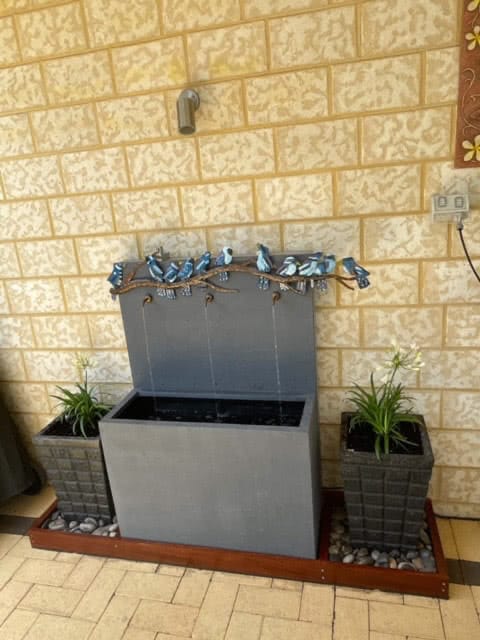
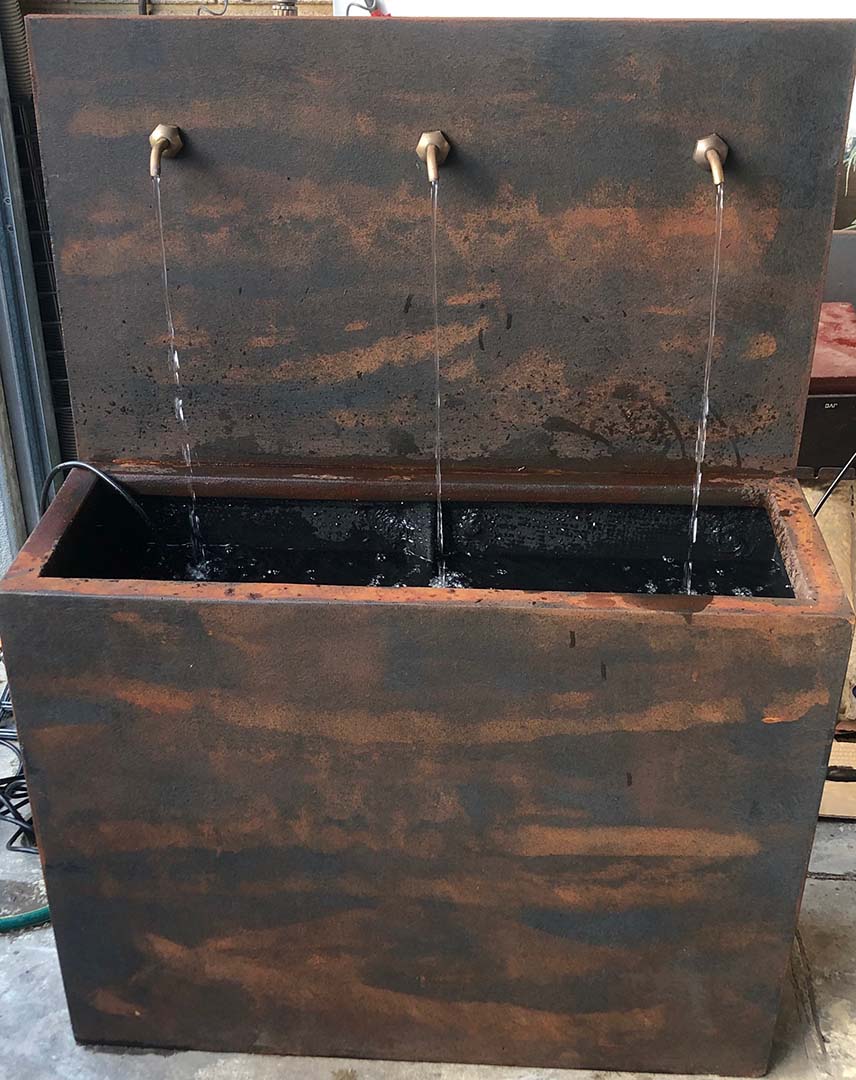
A round freestanding water bowl in a small courtyard eats into the walkway. This one does not. The back is flat, so the trough sits tight against a boundary wall, a garden fence or a balcony partition, and at 80 x 120 it runs along the wall rather than out into the seating area. We assemble each fountain in store from Polystone Resin divider troughs.
Water steps down three tiers of spouts, and that sound covers more street and neighbourhood noise than most people expect — in 18 years of showroom conversations it is the reason people buy a wall-sited fountain rather than a planter. Each unit is built to order in our Malaga workshop as a self-contained plug-and-play piece, and you can specify any finish from our complete range to sit with existing paving, render or screening. Take the 240 V mains pump where there is a weatherproof outlet within reach, or the 12 V low-voltage pump where there is not. Settle both the finish and the pump voltage before you order, because they are fixed at build. See the rest of our water features and fountains range, or contact us about a product or project and we will work through wall clearances and cable routing with you.
Will it mark a rendered wall?
Leave a 15 to 20 mm standoff gap between the trough and any rendered or painted wall. That air gap stops moisture being trapped against the surface and keeps mineral staining off the render, and it gives you a tidy channel to run the pump lead down the rear.
240 V or 12 V — which pump suits a balcony?
On a balcony, or in a garden bed that already has low-voltage lighting run to it, the 12 V low-voltage pump is the easier choice: the cabling can be handled safely without licensed mains conduit. Where a courtyard has a dedicated weatherproof 240 V point, take the standard 240 V mains pump and plug straight in.
Is it too heavy for a rooftop terrace?
Filled with water, the Polystone Resin trough is not light, so check the floor loading rating for your balcony or rooftop before you commit to a position. Set it down on a flat, level surface as well, or the water sits unevenly across the three spouts.
In a Perth summer, how often does the reservoir need topping up?
Weekly through the warm months. Moving water over three cascading tiers is exposed to warm air and afternoon breeze, so it loses volume faster than a still bowl does, and the submersible pump must never be allowed to run dry. A quick look at the reservoir once a week is enough.