

About Low Bowl Planter
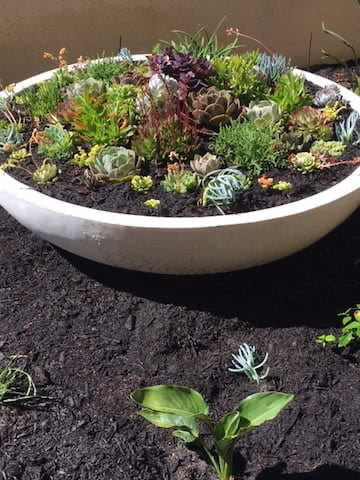
Surface area is the whole point of this shape. Planting space comes from the spread rather than the depth, so soil requirement stays moderate while the top of the bowl gives you a broad canvas to plant across. That suits shallow-rooted material: clumping succulents, sculptural agaves, foliage that trails over the rim. The low centre of gravity is the other half of it, because a planted bowl this flat is hard to knock over on an outdoor dining table or an exposed terrace.
Polystone Resin reads as natural masonry from two paces away and weighs a fraction of it. Across 18 years of showroom work I have watched this composite go through heavy winter rainfall, full summer sun and daily hose watering without warping or cracking, in open courtyards and under covered alfresco roofs alike.
The series is graded across eight sizes: the tabletop CG5024/40 (40 x 18) and CG5024/50 (50 x 21), the mid-range CG5024/70 (70 x 30), CG5024/85 (85 x 30) and CG5024/90 (90 x 40), then the landscape vessels CG5024/110 (92 x 24), CG5024/120 (120 x 27) and CG5024/150 (150 x 40). If the 150 x 40 is the size you are weighing up, compare it against the Large Low Bowl Planter, which is built as a dedicated oversize bowl. For matching containers in the same composite, view the Polystone Resin collection. One piece of practical advice before you order: chalk the diameter onto the paving or the table first. The 120 and the 150 take up more room than people picture.
Which plants hold up in a bowl this shallow?
Anything that spreads sideways rather than rooting deep. Clumping succulents do the most work here (Echeveria, Crassula, Haworthia), with ornamental grasses and dwarf bougainvillea for height, bird’s nest ferns in shaded positions, and a cascading groundcover such as Silver Falls dichondra to break the rim and fill the surface out.
What goes in the base before the potting mix?
Check the bottom drainage hole is clear first. Then a square of synthetic drainage mesh or geotextile fabric over the aperture, a 20 to 30 mm layer of coarse drainage aggregate on top of that, and a well-draining succulent or container potting mix above it. In a shallow bowl the aggregate layer matters more than usual, because there is less soil column to hold water away from the roots.
Can the smaller sizes sit on indoor furniture?
Yes, and the easiest way to do it with the 40 x 18 or the 50 x 21 is to drop shallow grower pots straight into the bowl over a plastic saucer. Plants can then be swapped or watered at the sink, and no runoff finds its way onto timber furniture or flooring.
Do the 120 x 27 and 150 x 40 dry out too fast through a Perth summer?
A broad surface does lose moisture faster on hot afternoons, so plan on more frequent watering than a tall pot of the same volume. Working in your favour, the dense composite walls buffer the root zone against sharp temperature swings. A 20 mm mulch layer of river pebbles or pumice over the soil surface cuts evaporation and keeps the mix from crusting.
Cleaning the Polystone Resin surface: what works, and what to keep away from it?
The composite surface is closed rather than porous, so dust, leaf litter and soil splash sit on top of it and come away with a hose and fresh water. Marks that hang on lift with a soft microfibre cloth and a little dishwashing liquid. Keep abrasive cleaning powders and wire sponges off it entirely, because the finish is part of the surface itself and scuffing shows permanently.