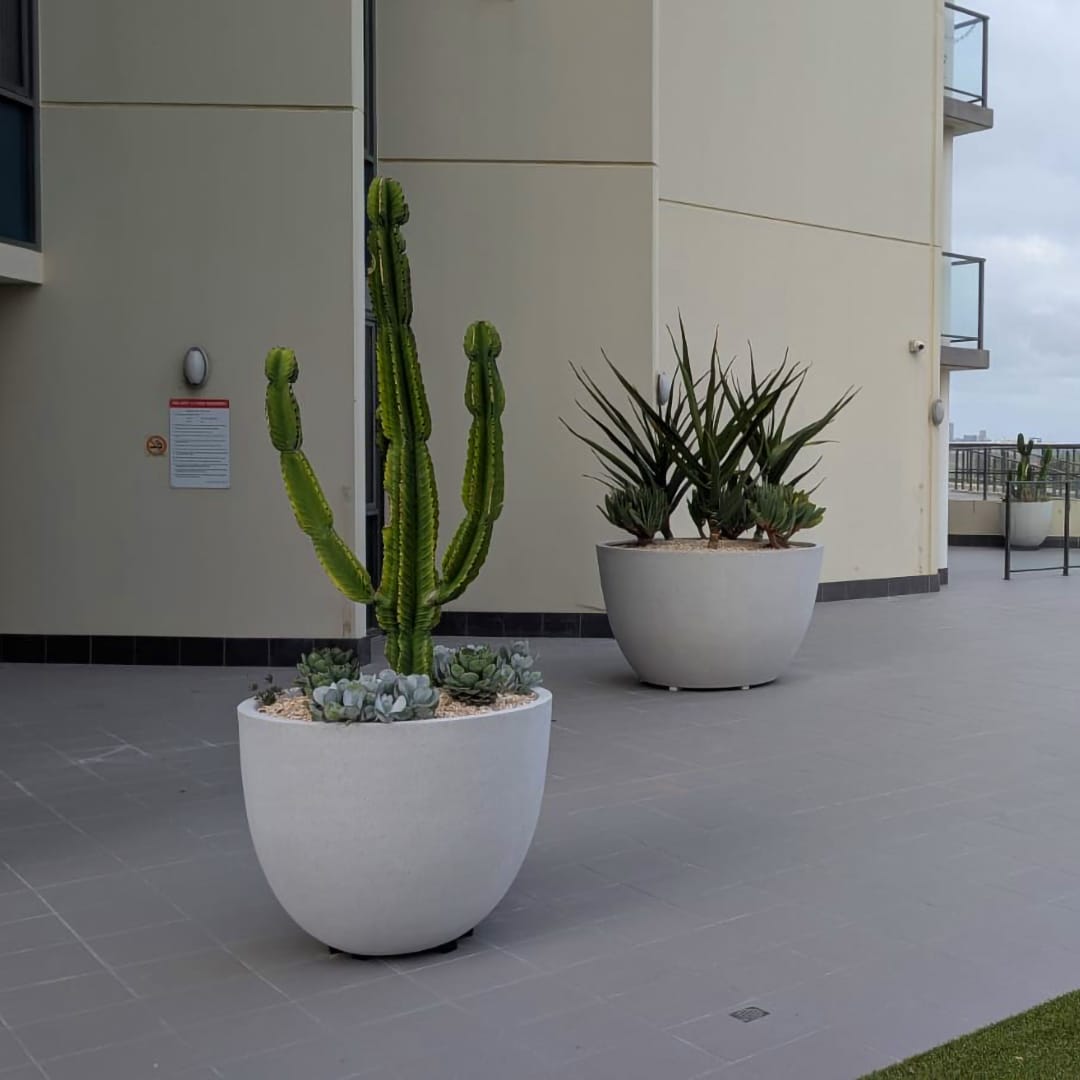
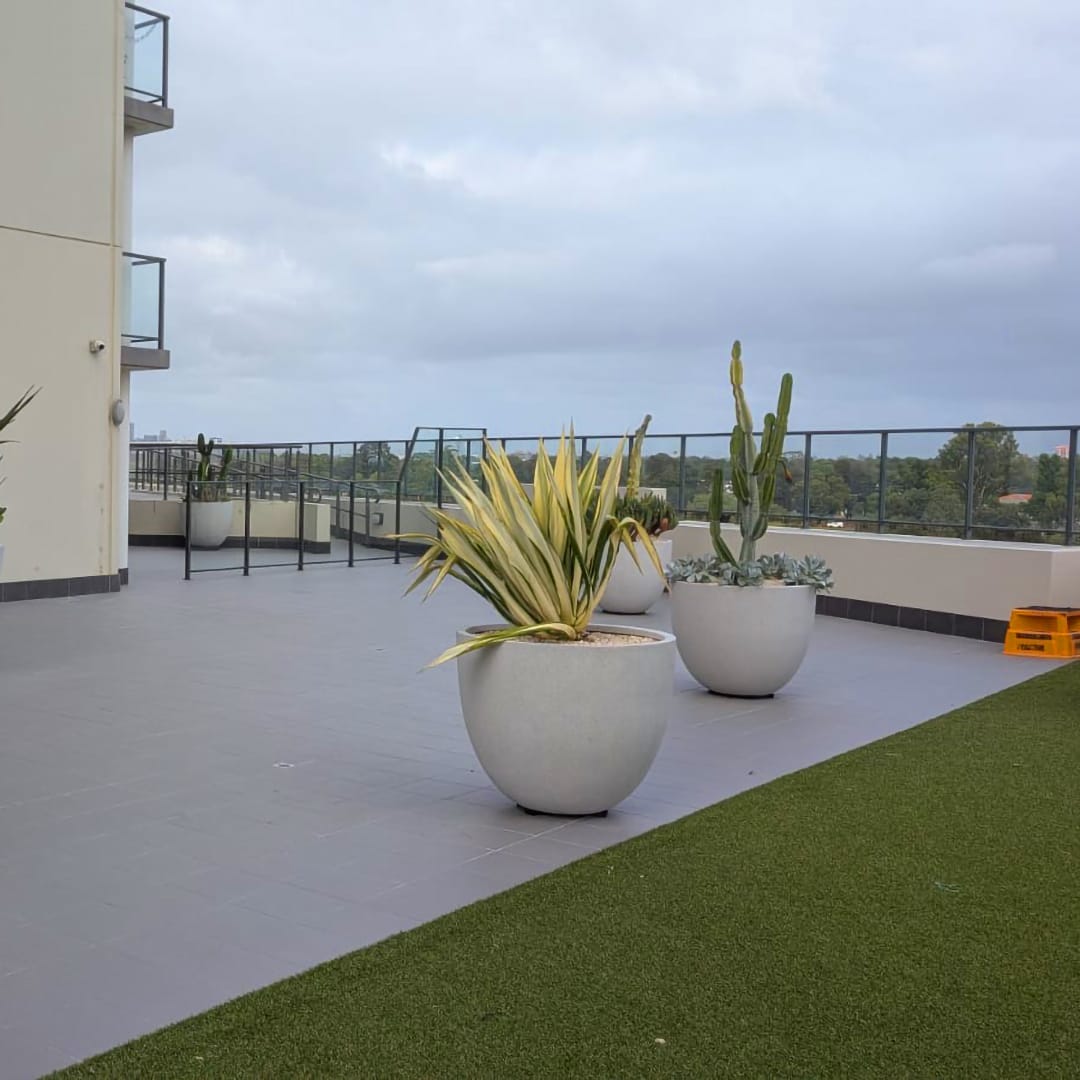
About Extra Large Egg Planter
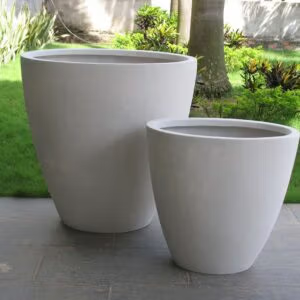
Ninety centimetres tall and 110 cm across at the belly (110 x 90H) — the proportions are the whole argument for this planter. At that size the curve reads as one continuous form from the far side of a forecourt or civic entry, where a rank of squares reads as street furniture. Larger residential gardens with room to walk right around it get the same effect.
Polystone Resin is what makes the scale workable. It is a composite rather than a cast masonry product, so the walls have the thickness and heft you expect from stone while the empty vessel stays manageable to lift, carry and set down. The material holds up under Perth's UV load, summer heat and winter rain without spalling, cracking or breaking down at the surface.
Inside there is enough soil volume for the root ball of a mature olive, a frangipani, a flowering crepe myrtle or a palm — the sort of specimen that sulks in a shallow container. Fill and plant it where it is going to stand, because nothing this size should be moved twice. If you need more again, the Giant Egg Planter runs to 1500 x 950 mm. Contact us about a product or project and we will work through access, delivery and placement before it lands on site.
What does the 110 x 90H need to stand on?
Filled with damp potting media and a mature tree, a vessel of this volume is heavy. Put it on a reinforced concrete slab, compacted roadbase, or paving rated for the load — and get it sitting in its final position while it is still empty. Planting first and shifting it afterwards is how paving gets damaged.
What goes in the bottom before the potting mix?
Check the base drainage aperture is clear first. Then lay either a heavy-duty drainage cell or 75 to 100 mm of washed blue metal aggregate across the floor, cover it with commercial geotextile filter fabric so the mix cannot wash down into the voids, and backfill above that with a high-grade, open-draining potting soil formulated for large woody specimens.
Why resin instead of precast concrete on a rooftop or podium slab?
Solid precast concrete planters at this size frequently exceed the structural floor limits of rooftop gardens and suspended podium slabs, and that is usually where a project stalls. Polystone Resin gives you the same visual weight and wall thickness as stone at a much lower tare weight, which makes both the crane lift and the structural sign-off simpler.
Does the curved belly do anything for roots in a heatwave?
It does. The wide, parabolic contour holds a large thermal mass of moist potting mix in the core of the planter, and that mass is slow to heat. Feeder roots sitting in the middle of it stay cooler through a run of hot Perth days than they would in a narrow container of the same height.
Can I pressure-wash it, and what else keeps the surface right?
No pressure washer — a blaster at close range will dull the factory finish on the composite. A hose down with fresh water two or three times a year clears garden dust, salt carried in off the coast and the tannin streaks that drip off overhanging foliage. Marks that stay put come off with a soft cloth and a little mild dishwashing liquid. Keep wire brushes and abrasive pads away from it altogether.