About Low Bowl 850
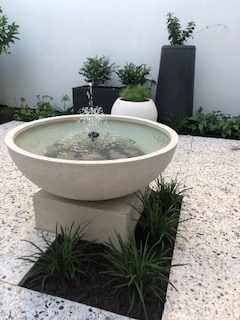
White Polystone Resin rather than cast stone — that is the trade this fountain makes. The composite reads as dressed masonry, crisp-edged and clean-faced, but it stays light enough that two people can carry the bowl and its 50 x 50 plinth into position, so there is no machinery to organise. The plinth lifts the dish clear of the paving and puts the moving water in plain view.
Three fountain head options change the character of the same bowl. Shower heads break the water into a wide bubbling aeration. Tall heads send up an upright vertical plume. Ball flow fittings sheet water in a smooth dome over a central sphere. Against dark green foliage, paved courtyard floors or timber decking, the white finish stays legible instead of sinking into the background. View the water features and fountains collection for the rest of the range, or contact us about a product or project. We run the nozzles on display in the Malaga showroom, which is the quickest way to hear the difference between the three heads before you decide.
Which fountain head throws the least spray in a tight courtyard?
The ball flow. It sheets water gently over a central sphere and keeps it inside the bowl perimeter, which is what you want in a confined patio. Shower and tall plume heads aerate water higher into the air and need open clearance around them — an afternoon sea breeze will carry the drift onto paving or furniture.
What keeps waterline marks off the white finish?
Polystone Resin is non-porous, so nothing soaks in. What you get instead is calcium and mineral deposit sitting on the surface, left behind as Perth tap water evaporates, and it shows on white more than on any other finish. Run a soft microfibre cloth around the interior every few weeks before the band builds up, and use a non-acidic fountain water conditioner to slow the scaling. Acidic descalers are the thing to keep away from a white composite bowl.
Does the 50 x 50 plinth need a prepared base?
Firm and level is the requirement — concrete pavers, a poured slab or level decking all do the job. Level matters more than people expect. Set the plinth off true and the water runs over one side of the bowl while the other side sits dry.
How often will it need topping up over summer?
Check the level every two to three days in warm weather. A broad circular bowl exposes a lot of open surface to the heat, so it loses more to evaporation than a narrow feature does, and the circulating pump has to stay submerged. Let it run low and the motor cavitates.