About Tall Drum Pot
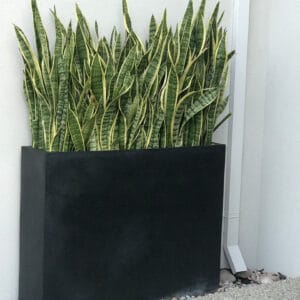
Courtyards run out of floor long before they run out of air. A narrow cylinder answers that: the plant volume goes upward instead of outward, so a single specimen can hold a veranda recess, an entrance foyer or the space beside a doorway column without narrowing the walkway.
Polystone Resin is what gives the pot its stone reading — the same tactile surface and visual weight as cut stonework, without the mass of solid concrete. That difference decides whether you reposition the pot later or plan the room around it. The composite shell handles covered alfresco, indoor and open patio use, and regular watering leaves the smooth surface as it was.
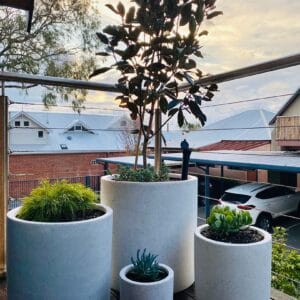
Both sizes are cut from one silhouette, the compact 28/33 x 70 cm model and the taller 40/50 x 100 cm vessel, so a pair set one forward of the other reads as a single arrangement rather than two pots that happen to match. If you want the same cylinder lower and wider, it is worth comparing the UV-Protected Drum Cylinder. Everything else we make in this material sits in the Polystone Resin Planters collection.
Common questions
Which plants suit a shape this tall?
Upright foliage suits it best: Ficus lyrata (fiddle-leaf fig), Sansevieria trifasciata, Zamioculcas zamiifolia (ZZ plant) and dwarf palms all sit well against a straight wall. If you want the vertical broken, Epipremnum aureum (pothos) or a trailing rhipsalis spilling over the rim gives you that contrast.
Which of the two sizes should I choose?
Take the 40/50 x 100 cm size where you want the plant read from across a room or from the street — an entrance, a bare wall, the end of a long alfresco. The 28/33 x 70 cm size is the one for tighter spots, beside a doorway or under a window, where a full metre of pot would crowd the line. Where the space is deep rather than wide, people often take one of each and set them one forward of the other.