About Divider Trough
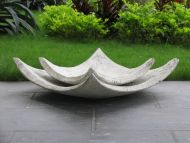
The curve is the reason to choose this trough over a plain rectangle. Each side wall bows outwards slightly along its length, which takes the hard edge off a masonry line without narrowing the planting cavity. Colour comes from pigment blended through the fibre cement mixture rather than sprayed on afterwards, so the stone tone runs right through the wall and a knock on a corner does not expose a different colour underneath.
Both sizes are sealed with waterproofing before dispatch, so they arrive ready to plant with no lining step on site. FS7082/80, at 80 x 30 x 80 cm, is the one for a perimeter run across an alfresco terrace, a pool deck or a foyer, where the screen has to read from the far side of the space. FS7082/60, at 60 x 20 x 60 cm, holds the same idea at 20 cm deep for balconies and narrow courtyard niches where a 30 cm footprint would crowd the walkway.
If you want the same dividing idea in Light Stone or Polystone Resin, the Divider Troughs listing runs to eight sizes. Work out your soil order before delivery day rather than after — the potting mix calculator will size it from the internal dimensions.
Which two sizes does the curved divider trough come in?
Two configurations, each with its own model code:
FS7082/80 — 80 x 30 x 80
FS7082/60 — 60 x 20 x 60
Is the colour painted on, or does it go through the material?
Through it. The trough is pigmented fibre cement, with the pigments blended into the composite mixture rather than applied to the surface, which is what gives it the stone look and keeps the finish hard-wearing.
Does it arrive sealed, or do I need to line it first?
Sealed. Each trough is treated with our documented waterproofing product before it leaves the warehouse, so it is ready for planting on arrival, indoors or outdoors.
Before planting, how should the base be built up for drainage?
Four steps, in this order, to keep roots off standing water and the outlet clear:
Position a section of fibreglass flyscreen over the base drainage hole.
Add a bottom layer of 20 mm blue metal aggregate across the base.
Place a second layer of fibreglass flyscreen over the aggregate to act as a soil barrier.
Fill with a quality free-draining potting mix and install plants.
Why choose bowed sides over a straight-sided trough?
A flat-sided trough draws a straight line across a space; these walls bow softly outwards, so the boundary has some movement in it. The curve sits in the wall, not the cavity — planting width and root volume stay the same.