About Flying Saucer
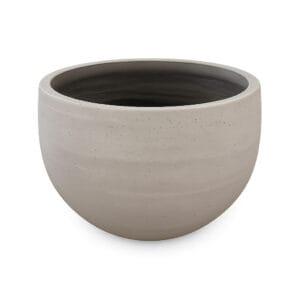
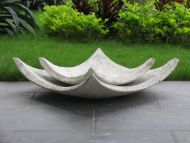
Shallow bowls plant differently to deep ones. The root ball sits close to the surface, water moves through quickly, and the arrangement is read from above rather than in profile. That is the job this shape is built for: a broad top opening over a low, curved body, cast in lightweight stone composite. It sits comfortably on a garden terrace, a poolside surround or timber decking, and works just as sensibly on a floor in a living room or a commercial reception foyer.
The material is where the practical difference sits. Moulded lightweight stone composite carries the texture and mineral tone of natural masonry without the weight of solid cast concrete, so the bowl can be lifted and set down somewhere else by one person. Sun angles change through the year and entertaining layouts change with them; a planter you can actually move is one that keeps earning its place.
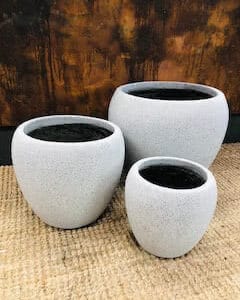
Outdoors it handles weather exposure, temperature swings and routine garden irrigation without any special treatment. If you are building a group of low bowls rather than buying a single piece, start with the Light Stone Planters collection and work out the proportions there. Sizes of this kind are easiest judged in person, so contact us about a product or project and we will check current stock and viewing in the Malaga showroom.
Common questions
What should I plant in a bowl this shallow?
Anything with a shallow root system. Succulents, massed annual flowers, dwarf ornamental grasses and mounding herbs all do well. The width is the real opportunity: run three or four species across the one bowl and let the trailing ones break over the curved rim. Use an open, gritty succulent or container mix rather than a heavy one, because a shallow bowl holds water right at the root ball. Skip plants that want depth, since they will be root-bound before the planting looks settled.
Does the stone composite keep the root zone cooler in summer?
Yes, and you notice it on the hot days. The composite mineral walls act as a thermal barrier, so soil temperature climbs more slowly through a heatwave. An unlined plastic dish does the opposite, passing heat straight into a root zone that has very little soil depth to buffer it.